
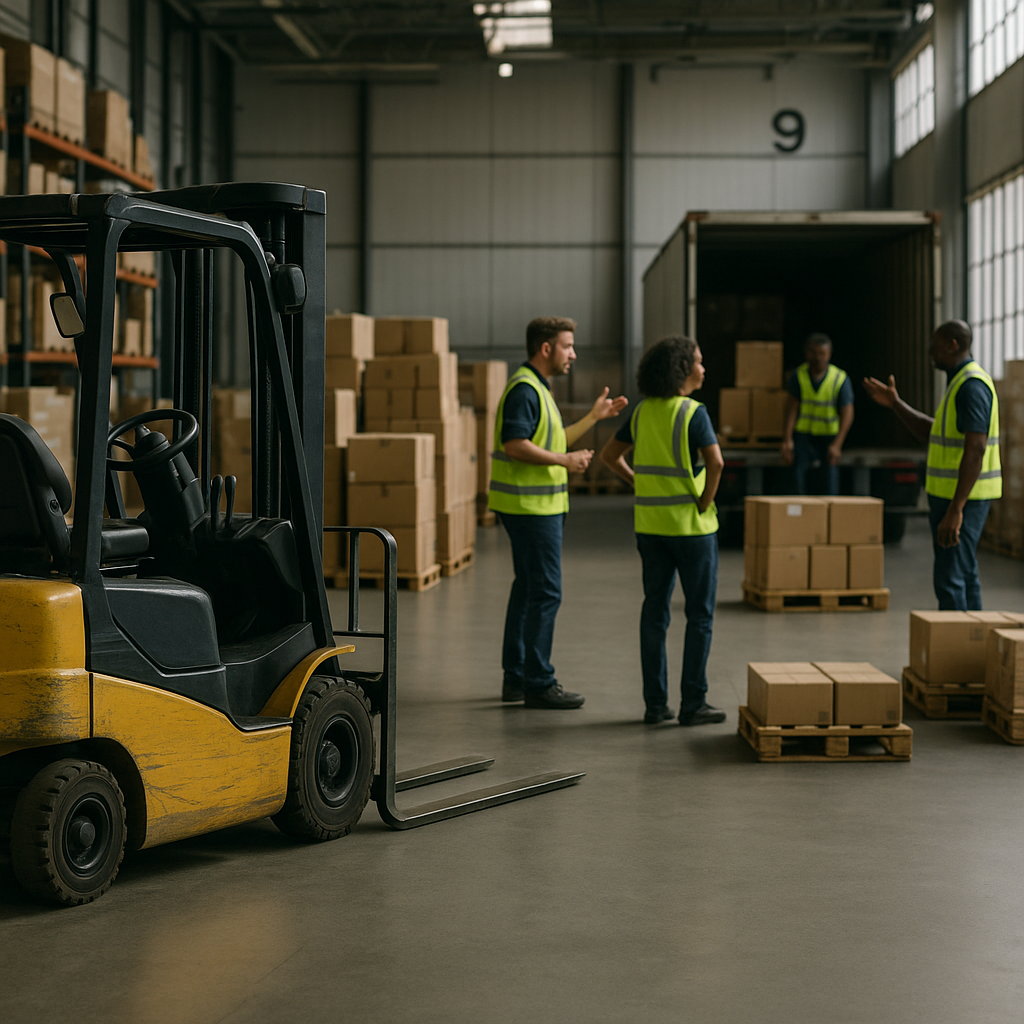
Most warehouse teams expect some level of equipment downtime. A conveyor motor burns out, a forklift goes offline, a stretch wrapper jams. These are seen as isolated incidents—annoying, but manageable. The real problem isn’t the breakdown itself. It’s how that breakdown quietly spreads disruption across labor, flow, and output.
On peak days, that ripple effect compounds fast. What looks like a 20-minute issue can end up costing hours of lost throughput, missed dispatch windows, and unnecessary labor spend.
The Illusion of “Localized” Downtime
In theory, equipment failures are contained. If a palletizer goes down, you reroute or manually handle pallets. If a conveyor stops, you divert flow elsewhere. But in practice, warehouse systems are tightly interconnected. One failure rarely stays in its lane.
Take a high-volume outbound operation. A single stretch wrapper goes offline during peak picking hours. At first, the team works around it—pallets are staged nearby, waiting to be wrapped later. Within 30 minutes, staging lanes are full. Pickers slow down because they have nowhere to drop completed pallets. Forklift drivers start double-handling loads to clear space. Suddenly, productivity drops across three different functions.
The original issue wasn’t catastrophic. The secondary effects are.
Throughput Loss Hides in Small Delays
Equipment downtime rarely shows up as a dramatic halt. Instead, it chips away at throughput in subtle ways:
– Operators waiting for shared equipment
– Increased travel time due to rerouting
– Temporary staging creating congestion
– Supervisors reallocating labor on the fly
– Extra handling steps added to “work around” the issue
Each of these might cost seconds or minutes. But across dozens of workers and hundreds of movements, those small delays stack into significant lost capacity.
What makes this dangerous is that it often doesn’t trigger alarm bells. The shift continues. Orders still move. But by the end of the day, targets are missed—and the root cause isn’t obvious.
Peak Volume Magnifies Fragility
On slower days, teams have the flexibility to absorb equipment issues. There’s spare capacity in labor and space. Work can be redistributed without major consequences.
Peak days remove that buffer.
Every lane is full. Every operator is occupied. Every piece of equipment is part of a tightly balanced system. When one element fails, there’s no slack to absorb the disruption.
This is why equipment downtime feels disproportionately worse during high-volume periods. It’s not just bad timing—it’s a system operating at maximum sensitivity.
The Maintenance vs. Operations Disconnect
One of the most common contributors to recurring downtime issues is the disconnect between maintenance planning and operational reality.
Maintenance teams often work on schedules based on time intervals or manufacturer recommendations. Operations teams, on the other hand, experience equipment stress based on volume spikes, product mix, and workflow changes.
For example, a conveyor system might technically be within its maintenance window, but if it’s been running at peak capacity for three consecutive weeks, the risk of failure is much higher than the schedule suggests.
Without alignment between these perspectives, preventive maintenance becomes reactive in disguise.
Workarounds That Become Permanent Problems
When equipment fails, teams adapt quickly. That adaptability is a strength—but it can also create long-term inefficiencies.
A temporary workaround introduced during downtime often sticks around long after the equipment is repaired. Extra staging areas remain in use. Manual processes become normalized. Travel paths stay longer than necessary.
Over time, the operation quietly shifts away from its designed flow.
Managers may not even realize how much throughput is being lost because the new process “feels normal.”
Visibility Is Often Too Late
Many warehouses track equipment downtime, but the data is often too high-level to drive meaningful change. A report might show that a forklift was down for 45 minutes or a conveyor stopped twice during a shift.
What it doesn’t show is:
– How many orders were delayed as a result
– How labor productivity changed during the event
– How congestion patterns shifted in response
– How long it took the system to recover fully
Without this context, downtime is treated as a maintenance issue rather than an operational performance driver.
Designing for Failure, Not Perfection
No warehouse can eliminate equipment downtime entirely. The goal isn’t perfection—it’s resilience.
Operations that handle downtime well tend to share a few characteristics:
They design alternate flows in advance, not in the moment. Instead of improvising during a breakdown, teams know exactly how work will be rerouted.
They maintain buffer capacity in critical areas. This might be extra staging space, flexible labor assignments, or backup equipment for high-risk points.
They prioritize equipment based on operational impact, not just repair cost. A minor failure in a critical path often deserves more attention than a major failure in a low-impact area.
They integrate maintenance and operations planning. Peak periods, product changes, and workflow adjustments are factored into maintenance decisions.
The Cost Isn’t Where You Think It Is
It’s easy to measure the direct cost of equipment downtime—repair expenses, spare parts, technician hours. But the bigger cost is usually hidden in lost throughput and operational inefficiency.
A single hour of reduced productivity across a large team can outweigh the cost of the repair itself. Missed dispatch windows can lead to penalties or strained customer relationships. Overtime required to recover lost output adds further expense.
And perhaps most importantly, repeated disruptions erode confidence on the floor. Teams become reactive instead of proactive, spending more time firefighting than executing.
Shifting the Mindset
To address equipment downtime effectively, it needs to be reframed. It’s not just a technical issue—it’s a flow issue.
Instead of asking, “How quickly can we fix this machine?” the better question is, “How does this failure affect the entire operation, and how do we minimize that impact?”
This shift changes how downtime is tracked, prioritized, and managed. It brings maintenance and operations into closer alignment and focuses attention on the true goal: maintaining consistent throughput.
Because in a warehouse environment, the real damage isn’t caused by the machine that stops. It’s caused by everything else that slows down because of it.
 English (Canada)
  Français du Canada