Most warehouse teams treat dock schedules as guidelines rather than hard commitments. On paper, it makes sense—transport is unpredictable, traffic happens, drivers run early or late. But in practice, this flexibility often creates a chain reaction that quietly erodes productivity across the entire operation.
The issue isn’t a single late truck. It’s what that delay triggers over the next 6–12 hours: labor misalignment, dock congestion, delayed outbound shipments, and frustrated teams working around constant disruptions. By the time the shift ends, the original delay is long forgotten, but the operational damage is already done.
The 30-Minute Delay That Becomes a 4-Hour Problem
Consider a typical inbound schedule: trucks are booked in 30-minute slots, with labor planned accordingly. A receiving team is staffed based on expected arrivals, and putaway resources are aligned to match the flow.
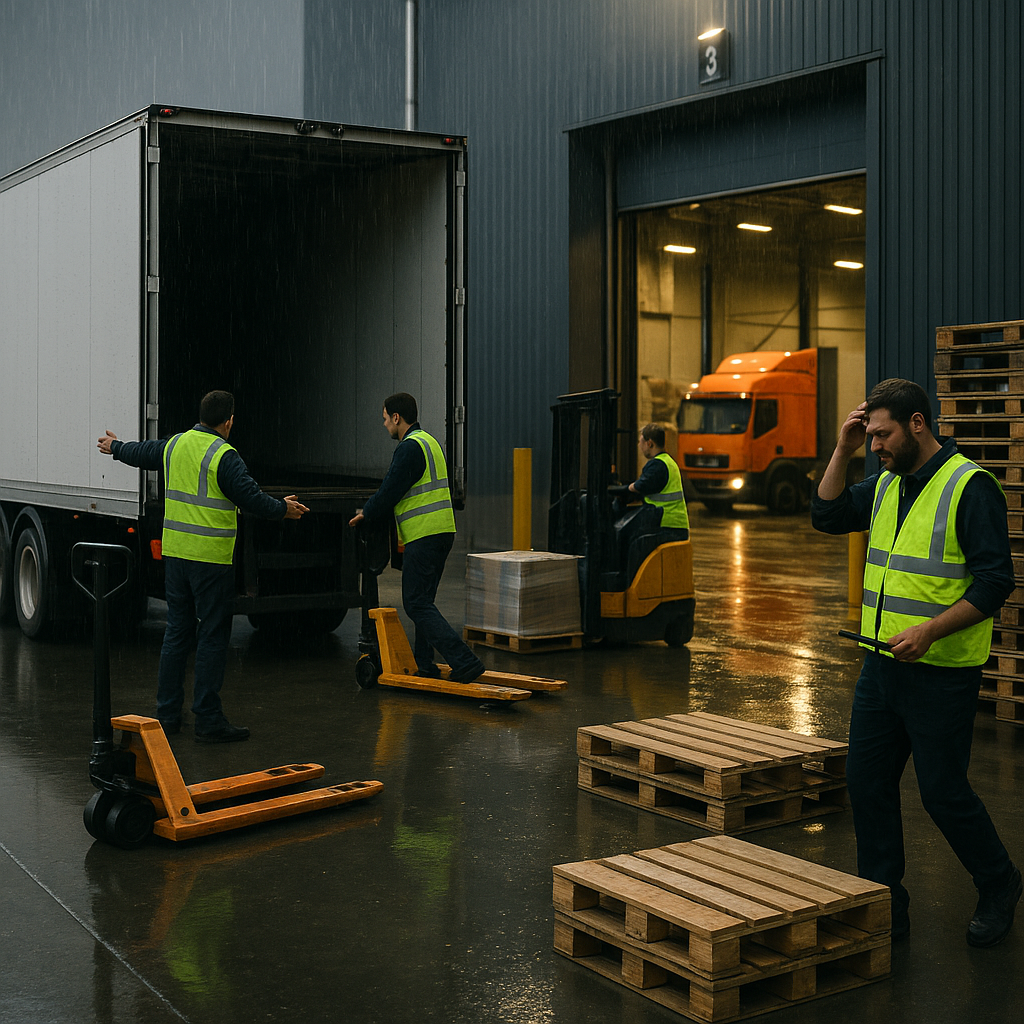
Now one truck shows up 45 minutes late. On its own, that doesn’t seem catastrophic. But during that 45-minute window, something else happens: another truck arrives early, a third shows up on time, and suddenly two loads are competing for one door.
Supervisors make a quick call—take the early truck to avoid idle time. It’s a reasonable decision in the moment. But when the late truck finally arrives, its slot is gone. Now it either waits in the yard or gets squeezed in wherever there’s space.
This is where the cascade begins.
The delayed truck pushes into the next slot, which pushes another, and within two hours the entire dock schedule is no longer a schedule—it’s a live negotiation. Yard drivers start reshuffling trailers. Forklift operators bounce between priorities. Receivers lose their rhythm.
And because warehouse labor is planned around expected flow, not chaotic surges, the team is suddenly either overwhelmed or underutilized at the wrong times.
Dock Congestion Isn’t About Space
When operations managers see congestion at the dock, the instinct is often to blame physical constraints—too few doors, not enough yard space, or poor layout.
But in many cases, the real issue is temporal, not physical.
When arrivals cluster due to schedule slippage, even a well-designed dock becomes congested. You end up with multiple trucks waiting, not because there’s no capacity over the day, but because demand is compressed into the same narrow window.
This creates several knock-on effects:
Drivers get frustrated and start pushing for priority unloading.
Teams rush to clear docks, increasing the risk of errors or damage.
Supervisors abandon planned workflows in favor of reactive decisions.
Meanwhile, earlier or later time slots may sit underutilized, but they’re no longer recoverable because the disruption has already shifted the workload.
The Hidden Impact on Outbound Operations
Inbound delays don’t stay contained within receiving. They bleed directly into outbound performance.
Late inbound product means delayed putaway. Delayed putaway means pick faces aren’t replenished on time. And that leads to pick delays, short shipments, or last-minute substitutions.
In many warehouses, outbound teams feel this as “random disruption”—sudden stockouts, urgent replenishment requests, or unexpected staging congestion. But the root cause often traces back to dock scheduling instability earlier in the day.
It’s especially visible in cross-dock or fast-moving environments, where inbound and outbound are tightly linked. A late inbound truck doesn’t just delay receiving—it directly jeopardizes outbound departure times.
Why Flexibility Backfires
Most operations pride themselves on being flexible. “We’ll work trucks in,” “We won’t turn drivers away,” “We’ll make it fit.”
That mindset is understandable, especially when carrier relationships matter. But too much flexibility at the dock often creates worse outcomes for everyone involved.
When schedules aren’t enforced, carriers have little incentive to arrive on time. Early arrivals become common, late arrivals are tolerated, and the schedule loses credibility.
Eventually, the dock operates on a first-come, first-served basis disguised as a schedule. At that point, planning becomes nearly impossible.
Labor teams can’t rely on expected volumes. Supervisors spend more time firefighting than managing. And small disruptions escalate into full-shift inefficiencies.
What Effective Dock Scheduling Actually Looks Like
Fixing this doesn’t require perfect punctuality—it requires consistency and consequences.
Strong dock scheduling operations typically share a few characteristics:
Appointments are treated as commitments, not suggestions.
Early arrivals are managed just as tightly as late ones.
There’s a defined policy for missed slots—whether that means waiting or rescheduling.
Yard visibility is real-time, so decisions aren’t made blindly.
One of the most effective changes is counterintuitive: limiting flexibility.
For example, instead of immediately accommodating a late truck, some operations require it to wait until the next available slot. This feels harsh in the moment, but it quickly reinforces schedule discipline across carriers.
Similarly, holding early arrivals until their scheduled time prevents artificial congestion and protects the integrity of the plan.
These policies only work if they’re applied consistently. The moment exceptions become common, the system reverts to chaos.
The Role of Communication and Visibility
Even with strong scheduling rules, real-world variability doesn’t disappear. Trucks will still run late. Traffic and weather will still interfere.
The difference is how early the operation knows about it.
Warehouses that actively track inbound ETAs—through TMS integration, carrier updates, or yard systems—can adjust before the disruption hits the dock.
If a truck is known to be 90 minutes late, its slot can be reassigned proactively rather than reactively. Labor can be shifted. Yard plans can be updated.
Without that visibility, every delay becomes a surprise—and surprises are what drive the cascade effect.
Stability Is More Valuable Than Speed
There’s a common belief that maximizing dock utilization means constantly keeping doors full. In reality, stable flow is far more valuable than maximum utilization at any given moment.
A dock running at 85% utilization with predictable flow will outperform one swinging between overload and idle time. Teams work more efficiently when they can maintain rhythm, and errors decrease when operations aren’t constantly being reshuffled.
Dock scheduling isn’t just about assigning time slots—it’s about protecting that rhythm.
When arrivals are controlled and predictable, everything downstream improves: labor planning, equipment usage, inventory flow, and outbound performance.
And when they’re not, even the best-run warehouse ends up chasing problems that started with a single late truck.
 Français du Canada
  English (Canada)