
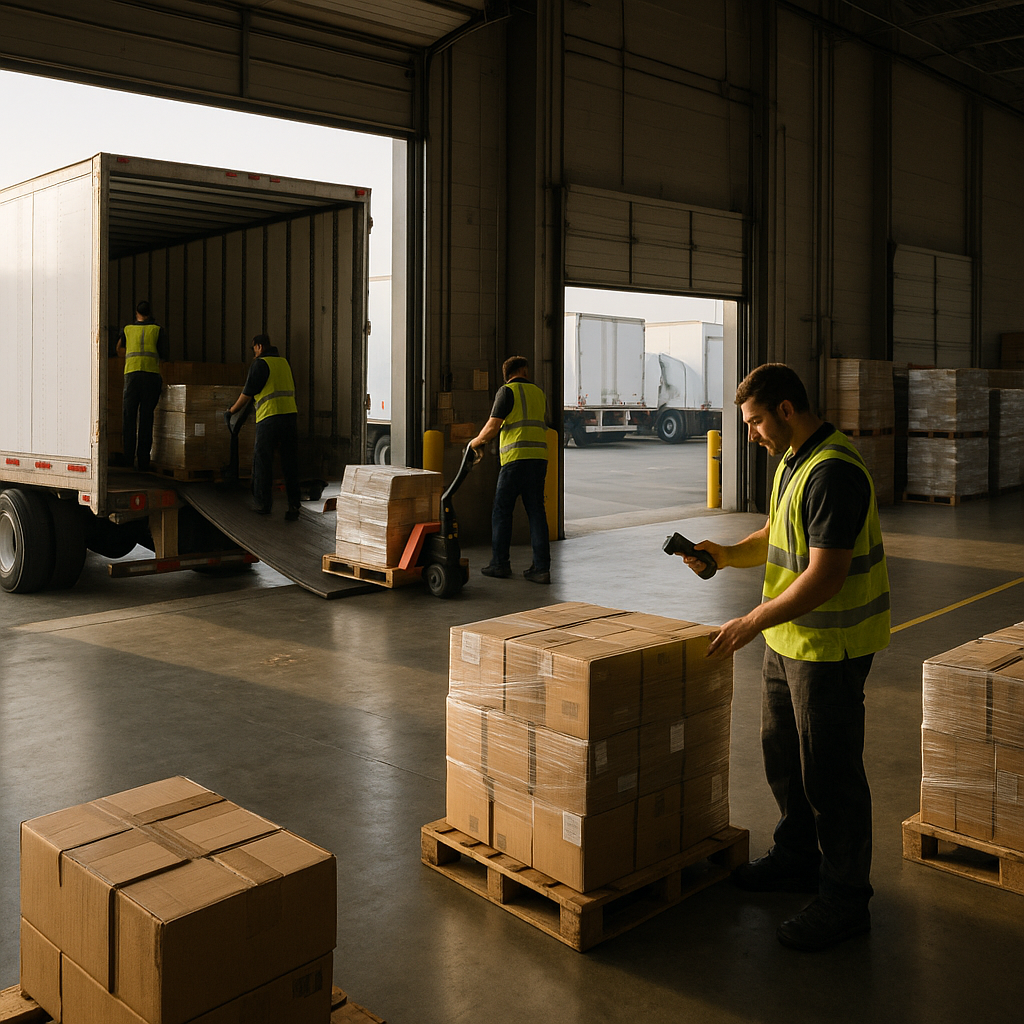
Most warehouse leaders recognize congestion when they see trucks backed up outside the gate. What’s less obvious—and far more damaging—is the invisible queue forming inside the operation when dock scheduling is misaligned with reality.
On paper, the schedule might look tight and efficient. Appointments are spaced evenly, labor is allocated by the hour, and every dock door is “fully utilized.” But step onto the floor, and a different picture emerges: inbound trucks arriving in clusters, outbound loads waiting for staging space, supervisors reshuffling priorities mid-shift, and forklifts idling while paperwork catches up.
This isn’t a capacity problem. It’s a synchronization problem. And it quietly strangles throughput.
The Illusion of a Full Schedule
A fully booked dock schedule often feels like success. Every slot is filled, carriers are committed, and utilization metrics look strong. But fullness doesn’t equal flow.
The issue starts with how appointments are created. Many warehouses assign fixed time slots without factoring in variability: differences in unload times, pallet quality, product mix, or even driver readiness. A truck carrying floor-loaded cartons behaves very differently from one with neatly palletized freight, yet both may be given the same 60-minute window.
As variability stacks up, small delays cascade. A truck that runs 20 minutes over pushes the next appointment off schedule. Multiply that across a shift, and suddenly the dock is reacting instead of executing.
The result is a hidden queue—not outside the building, but inside the workflow. Freight is waiting for doors. Doors are waiting for labor. Labor is waiting for instructions.
Clustering: The Real Bottleneck
Even with a structured schedule, many operations experience “appointment clustering.” This happens when multiple carriers arrive early—or late—and converge on the same window.
Consider a common morning scenario. Five inbound trucks are scheduled between 8:00 and 9:00 AM. Two arrive early at 7:30 hoping to get ahead. Three arrive at 8:15 due to traffic delays. Now, instead of a smooth sequence, you have five trucks competing for doors at the same time.
Without strict enforcement or dynamic rescheduling, the dock team improvises. Supervisors start making judgment calls: which load is urgent, which carrier is reliable, which product is needed first. These decisions are often correct in isolation—but collectively they disrupt the plan.
Meanwhile, outbound operations feel the impact. Staging areas fill up, completed orders wait longer for doors, and shipping deadlines tighten.
The Labor Mismatch Problem
Dock scheduling doesn’t just affect trucks—it directly impacts labor productivity.
When inbound arrivals bunch together, labor demand spikes. Teams scramble to unload multiple trucks at once, often pulling workers from other tasks. Then, just as quickly, the workload drops off, leaving people underutilized.
This creates a stop-start rhythm that kills efficiency. Forklift operators spend more time waiting or repositioning than moving product. Supervisors spend more time reallocating labor than managing flow.
Over time, this inconsistency leads to fatigue and frustration. Workers feel the pressure during peaks and disengagement during lulls. Neither state is productive.
Dock Doors Are Not Interchangeable
Another common issue is treating all dock doors as equal. In reality, each door has constraints—proximity to staging zones, suitability for certain product types, or access to specific equipment.
When scheduling ignores these nuances, inefficiencies multiply. A truck assigned to a distant door may require longer travel time for putaway. A load needing specialized handling might end up waiting because the correct equipment isn’t nearby.
This mismatch often forces last-minute door changes, adding confusion and delay. What looked like a simple adjustment creates ripple effects across the shift.
Carrier Behavior Shapes the Outcome
Dock scheduling doesn’t exist in isolation—it’s influenced heavily by carrier behavior.
If carriers know that early arrivals are accepted, they’ll show up early. If late arrivals face no consequences, schedules lose meaning. Over time, the appointment system becomes more of a suggestion than a structure.
This unpredictability makes planning nearly impossible. Even the best-designed schedule can’t hold if external partners don’t follow it.
Strong operations set clear expectations and enforce them consistently. That doesn’t mean being rigid—it means being predictable. Carriers adjust quickly when rules are clear and consistently applied.
The Compounding Effect on Throughput
Individually, each of these issues seems manageable. A delayed truck here, a crowded hour there. But together, they create a compounding effect.
Throughput slows not because of a single failure, but because of accumulated friction:
– Trucks spend more time waiting for doors
– Labor spends more time adjusting than executing
– Equipment utilization becomes uneven
– Supervisors shift from planning to firefighting
By the end of the day, the warehouse may still complete its workload—but with more effort, more stress, and less consistency.
This is the silent cost of poor dock scheduling. It doesn’t always show up in obvious metrics, but it erodes performance over time.
Restoring Flow Through Better Scheduling Discipline
Improving dock scheduling isn’t about adding complexity—it’s about aligning the schedule with operational reality.
Start by acknowledging variability. Not all loads are equal, so time slots shouldn’t be either. Build flexibility into the schedule to account for different unload times and product characteristics.
Next, focus on smoothing arrivals. Instead of packing appointments into convenient blocks, spread them to match actual handling capacity. This reduces clustering and stabilizes labor demand.
Enforcement also matters. Clear policies for early and late arrivals help maintain structure. When carriers trust that the schedule will be followed, they’re more likely to comply.
Finally, connect scheduling with execution. Real-time visibility into dock activity allows teams to adjust proactively rather than reactively. When delays occur, they can be managed before they cascade.
The Payoff: Predictability Over Chaos
Well-managed dock scheduling doesn’t just reduce delays—it transforms the rhythm of the warehouse.
Trucks arrive in a steady flow. Labor demand becomes predictable. Equipment is used consistently. Supervisors spend less time reacting and more time optimizing.
Most importantly, throughput increases without adding resources. The operation simply flows better.
That’s the real opportunity. Not more doors, not more labor—but better synchronization between what’s planned and what actually happens.
Because in warehouse operations, the biggest constraints are often not physical. They’re hidden in the gaps between schedule and execution.
 Français du Canada
  English (Canada)