
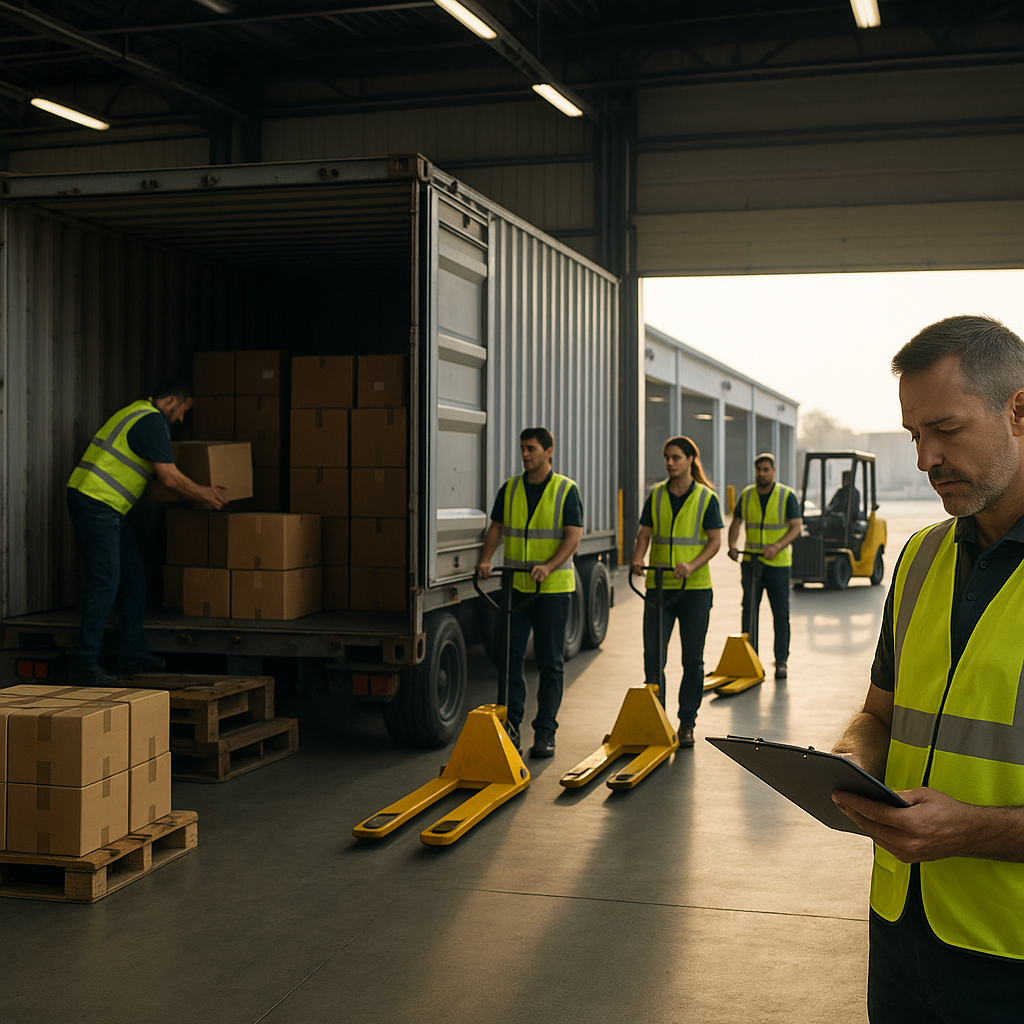
The Real Cost of Slow Container Unloading
For many warehouse and operations managers, container unloading is treated as a routine, predictable task. Trucks arrive, containers are opened, goods are unloaded, and the workflow continues. But when unloading becomes inconsistent or slow, it creates a bottleneck that quietly disrupts everything downstream—from putaway to order fulfillment.
This issue is often underestimated because it happens at the very front of the operation. Yet, when unloading efficiency drops, the consequences compound quickly: dock congestion increases, labor becomes misaligned, and inventory visibility suffers. Over time, what seems like a minor delay at the dock can translate into missed shipping deadlines, higher labor costs, and strained carrier relationships.
A Common Scenario on the Warehouse Floor
Imagine a typical morning shift. Three containers are scheduled to arrive between 8:00 and 10:00 AM. The first truck arrives on time, but unloading takes longer than expected due to poorly stacked cargo and a lack of available labor. By the time the second truck arrives, the dock is still occupied.
Now the second driver waits. The third truck shows up early, adding to the congestion. Meanwhile, inside the warehouse, putaway teams are idle because product isn’t flowing in as expected. Later in the day, when unloading finally catches up, the warehouse suddenly faces a surge of inbound inventory, overwhelming staff and space.
This stop-and-start rhythm creates inefficiencies that ripple across the entire operation. Labor is either underutilized or overburdened, workflows become reactive instead of planned, and managers are forced into constant firefighting.
Where the Inefficiencies Come From
Slow container unloading rarely has a single cause. Instead, it’s usually the result of several overlapping inefficiencies that compound over time.
One major factor is inconsistent labor availability. Many warehouses rely on fixed staffing levels, even though inbound volumes fluctuate daily. When a container arrives that requires more time—due to floor-loaded cargo, irregular packaging, or heavy items—teams quickly fall behind.
Another common issue is lack of specialization. Unloading is physically demanding and requires a specific rhythm and technique to be done efficiently. When general warehouse staff are rotated into unloading tasks without proper training or experience, productivity drops and fatigue increases.
Dock scheduling also plays a significant role. Without precise appointment management, containers arrive in clusters rather than being spaced out. This creates immediate congestion and forces teams to multitask in ways that reduce efficiency.
Finally, poor cargo visibility can slow everything down. When teams don’t know what’s inside a container—or how it’s loaded—they can’t prepare the right equipment or staffing in advance. This leads to delays from the moment the container doors open.
Why This Bottleneck Spreads Across Operations
Container unloading sits at the very beginning of your inbound workflow. When it slows down, every subsequent process is affected.
Putaway teams depend on a steady flow of goods. If unloading is delayed, they wait. If unloading suddenly speeds up later, they’re overwhelmed. This imbalance leads to inconsistent productivity and increased error rates.
Inventory accuracy also suffers. When goods sit on the dock longer than expected, they may not be scanned or recorded promptly. This creates discrepancies between physical stock and system data, which can impact order fulfillment.
Even outbound operations can feel the effects. If inbound goods aren’t processed on time, they may not be available for picking when needed. This can delay shipments and damage service levels.
In short, slow unloading doesn’t stay contained at the dock—it disrupts the entire warehouse ecosystem.
How to Identify the Problem Early
Many operations managers don’t realize how much time is being lost at the unloading stage because it’s not always tracked in detail. To identify the issue, start by measuring key metrics such as average unload time per container, dwell time at the dock, and labor hours per unload.
Look for patterns. Are certain types of containers consistently taking longer? Are delays more frequent during specific shifts or days of the week? Do bottlenecks coincide with multiple arrivals?
Another useful indicator is dock congestion. If trucks are frequently waiting for available doors, it’s a clear sign that unloading throughput isn’t keeping pace with inbound volume.
Practical Ways to Improve Unloading Efficiency
Fixing this bottleneck doesn’t necessarily require a complete overhaul of your operation. In many cases, targeted improvements can deliver significant results.
One of the most effective solutions is to introduce flexible labor specifically for container unloading. Instead of relying solely on fixed staff, having access to trained unloading teams allows you to scale up quickly when volume spikes. This keeps containers moving and prevents backlog.
Specialization also matters. Dedicated unloading teams work faster and more safely because they develop consistent techniques and workflows. Over time, this leads to shorter unload times and reduced fatigue-related errors.
Improving dock scheduling can make a big difference as well. Spacing out container arrivals—even by 30 to 60 minutes—can prevent congestion and allow teams to focus on one unload at a time. Coordinating with carriers and suppliers is key to making this work.
Another practical step is pre-planning based on container data. When possible, gather information about the contents and loading style in advance. This allows you to assign the right number of workers and prepare the necessary equipment before the container arrives.
Finally, standardizing unloading processes can eliminate wasted motion. Simple changes—such as consistent pallet staging areas, clear workflows, and defined roles—help teams work more efficiently and reduce confusion on the dock.
The Role of External Support
For many warehouses, partnering with a logistics provider that specializes in container unloading can be a strategic advantage. These providers bring trained crews, proven processes, and the flexibility to handle fluctuating volumes.
Instead of stretching internal teams or scrambling to adjust schedules, managers can rely on external support to maintain consistent throughput. This not only improves efficiency at the dock but also stabilizes the entire operation.
In high-volume environments, this kind of support can be the difference between a smooth, predictable workflow and a constant cycle of delays and recovery.
Turning the Dock Into a Strength
Container unloading may seem like a small piece of the overall operation, but it has an outsized impact on performance. When done efficiently, it creates a steady, reliable flow of goods that supports every downstream process.
By identifying inefficiencies, improving labor strategies, and optimizing scheduling, warehouse managers can turn the dock from a bottleneck into a competitive advantage.
The key is to treat unloading not as a routine task, but as a critical control point—one that sets the pace for everything that follows.
 English (Canada)
  Français du Canada